The Smart Path to Discovering the World’s Most Demanded Mineral
As the world races toward clean energy, lithium has become one of the most strategic minerals of the 21st century. It powers electric vehicle batteries, smartphones, solar storage systems, and the fast-growing global tech infrastructure. Demand is rising every year — and so is the need for smarter, more efficient exploration methods.
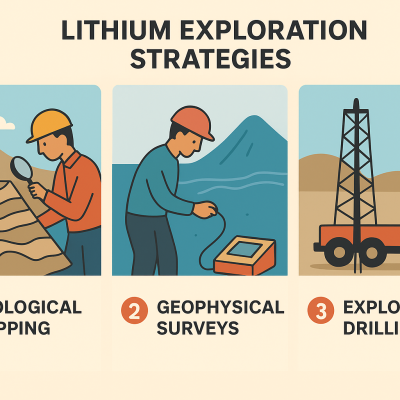
Finding lithium isn’t just about digging; it requires data, technology, geological knowledge, and a strategic approach. Below is a clear guide to the top lithium exploration strategies that help mining companies discover new deposits while reducing risks and increasing success rates.
1. Geochemical Surveys: Let the Earth Reveal Its Clues
Geochemical surveys are one of the most dependable ways to detect potential lithium zones. They involve sampling soil, rocks, brines, or sediments to determine whether lithium concentrations are present.
Why it Works
- Lithium often leaves chemical signatures on the surface.
- Easy to detect anomalies that indicate deeper deposits.
- Works well for both hard-rock lithium (spodumene) and brine lithium.
Methods Used
- Soil sampling in target areas
- Rock/chip sampling along outcrops
- Brine analysis for salt lake (salars) exploration
- Stream sediment surveys around river channels
Geochemical mapping narrows down exploration zones and significantly reduces wastage of time and resources.
2. Geophysical Methods: Seeing Below the Earth Without Digging
Geophysics helps explorers “see” underground structures using non-invasive technology. These tools help locate the geological features that typically host lithium.
Key Techniques
- Magnetotellurics (MT): Ideal for brine lithium; detects deep underground fluids.
- Gravity surveys: Identifies basin structures where lithium-rich brines accumulate.
- Electromagnetic surveys (EM): Detects conductive zones associated with minerals.
- Seismic surveys: Maps subsurface layers and rock formations.
Why it Matters
- Cuts down exploration cost
- Prevents random drilling
- Increases discovery accuracy
- Works in both remote and complex terrains
Geophysics is now a global standard because it combines scientific precision with economic efficiency.
3. Targeted Drilling & Core Sampling: Confirming the Discovery
Once geochemical and geophysical data point to a promising location, drilling becomes the final confirmation step.
How it Works
- Explorers drill deep holes into the earth.
- Extract rock cores or fluid samples.
- Analyze them in labs for lithium grade, deposit size, water content (for brines), and mineral structure.
Why This Step Is Critical
- It provides the actual proof of lithium presence.
- Helps estimate long-term mining value.
- Identifies whether the deposit is economically viable.
- Determines which extraction method will be used.
Targeted drilling ensures that resources are invested only in real opportunities, not assumptions.
Why These Strategies Stand Out
Modern lithium exploration is no longer about chance — it is data-driven, science-backed, and technology powered. The combination of:
- Geochemical intelligence
- Geophysical mapping
- Strategic drilling
creates a highly effective roadmap that reduces risk and boosts success.
These methods allow exploration teams to discover lithium faster, more sustainably, and more profitably.
Conclusion: The Future Belongs to Smart Lithium Explorers
As global competition for lithium intensifies, the winners will be those who use advanced tools and clear strategies. Whether for hard-rock deposits or brine reserves, investing in smart exploration today positions any mining company at the center of tomorrow’s energy transformation.
Lithium is powering the future — and the future favors those who explore wisely.